
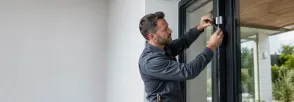
Get Your Quote for Door And Window Contact Installation
Fill the form below to inquire about Electrical Services Ontario's Door And Window Contact Installation in Markham.
Phone Electrical Services Ontario at (289) 672-2825 for Door And Window Contact Installation in Markham and catch entry at the door.
Fill the form below to inquire about Electrical Services Ontario's Door And Window Contact Installation in Markham.

A visible plastic sensor stuck to every door frame is not the only way to protect an entry point. Door And Window Contact Installation Markham can go recessed and completely hidden, or surface-mounted and quick, depending on what actually matters most for the property.
Most homeowners across Markham never think about which type of contact sensor is going onto their doors and windows until they see a technician holding two very different-looking parts. Surface-mounted contacts are the visible plastic blocks most people picture when they think of an alarm sensor, while recessed contacts disappear entirely into a drilled hole in the door and frame. Both accomplish the same core job, detecting when an entry point opens, but every Door And Window Contact Installation Markham we complete depends on the door, the window, and how much the homeowner cares about seeing hardware on their trim.
A door or window contact only detects when the entry point physically opens, which means a window broken and left in its closed frame will not trigger a contact sensor at all. Glass-break detectors listen for the specific acoustic signature of breaking glass and cover this gap, making them a common addition alongside contacts on ground-floor windows where forced entry through the glass itself is a realistic risk.
Not every window across Markham needs a glass-break detector paired with its contact, since upper-floor windows or those without easy exterior access carry a lower risk profile that a contact alone typically covers adequately. Ground-floor windows in less visible areas of a property, however, are where this combination earns its cost most consistently.
Surface-mounted contacts install with screws or adhesive directly onto the visible surface of the door or window frame, making them the faster and less invasive option since no drilling into the door itself is required. Recessed contact installation drills a small hole into both the door and the frame so the sensor and magnet sit completely hidden, visible only from the door's edge when it is open, a detail many homeowners only appreciate once they see it finished.
Recessed contacts cost more to install because of the drilling involved and are not always possible on every door, since hollow-core doors or certain frame materials cannot reliably house a recessed sensor. Surface-mounted contacts work on virtually any door or window and remain the more practical choice when speed, cost, or an unusual frame material rules out recessing.
Door And Window Contact Installation typically ranges from $30 to $75 per contact depending on whether the sensor is surface-mounted or recessed and wired or wireless. A standard home with 8 to 12 entry points usually sees a total project cost between $250 and $700.
Surface-mounted contacts install with screws or adhesive directly onto the visible frame surface, while recessed contacts are drilled into the door and frame so the sensor and magnet are completely hidden. Recessed contacts cost more due to the drilling but leave no visible hardware.
Wireless contacts dominate the consumer market because they install without wiring and can be added or moved easily, running on batteries that typically last several years. Wired contacts remain common in commercial buildings or new construction where low-voltage wiring is already planned.
This usually points to a misaligned sensor and magnet, where the gap has grown too wide, often from door sag or frame settling over time. Most sensors require the gap to stay within about half an inch for reliable reporting.
It depends on the window's risk profile. A contact only detects when the window opens, not when the glass breaks while closed, so ground-floor windows in less visible areas often benefit from adding glass-break detection alongside the contact.
The main entry door typically needs an Entry/Exit zone, which gives a delay window to disarm the system after opening. A ground-floor window rarely used as an entry point usually warrants an immediate Perimeter zone instead.
Yes. Old contact hardware rarely transfers cleanly to new frames with different dimensions or materials, so new doors and windows installed during a renovation need their contacts reinstalled as part of the project rather than as an afterthought.
A sliding patio door moves horizontally rather than swinging on hinges, which means a standard surface-mounted contact needs different placement than what works on a hinged door, typically positioned along the horizontal track rather than the vertical frame edge. Getting this placement wrong is one of the more common installation mistakes on properties with sliding doors.
Garage doors, basement hatches, and other non-standard openings across Markham often need contacts rated for a wider gap tolerance or a different mounting approach entirely, since these openings rarely close with the same precision as a standard hinged door or double-hung window. A contact designed for a tight-tolerance window will frequently misreport on an opening that never closes to exactly the same position twice.
Door And Window Contact Installation Markham typically ranges from $30 to $75 per contact depending on whether the sensor is surface-mounted or recessed, wired or wireless, and how many entry points need coverage. A standard home with 8 to 12 doors and windows typically sees a total project cost between $250 and $700 once all entry points are covered.
Recessed contacts generally run higher per unit than surface-mounted ones due to the drilling time involved, and wired contacts cost more in labor than wireless if the property does not already have low-voltage wiring run to each opening. Homeowners across Markham upgrading from an older wired system to a modern wireless setup often find the per-contact cost drops once the wiring labor is removed from the equation.
The total project cost also depends on how many entry points genuinely need coverage versus how many a homeowner assumes need it. A home with a dozen windows might reasonably contact only the ground-floor and easily-accessed second-floor openings, while a property with a history of attempted entry might justify covering every single window regardless of floor level. If you are unsure which openings apply to your property, simply contact us and our team can walk through it with you before scheduling anything.
Wired contacts connect directly to the alarm panel through low-voltage cable run inside the wall, which remains common in commercial buildings and larger custom homes where wiring was planned into the original construction. Wireless contacts communicate to the panel over radio frequency and dominate the consumer market today because they install without any wiring and can be moved or added to easily later.
Wireless contacts run on replaceable batteries that typically last several years under normal use, while wired contacts draw power from the panel itself and never need a battery. Retrofitting an older home with wired contacts is rarely worth the labor cost compared to wireless, but a new-construction project already running wiring for other systems sometimes finds wired contacts add little additional cost.
Door And Window Contact Installation Markham starts with walking every entry point on the property to confirm which contact type and mounting method fits each specific door or window, since a single home often needs a mix of surface-mounted and recessed contacts depending on the frame material and homeowner preference at each opening. This assessment happens before any drilling or mounting begins, so the homeowner knows exactly what each entry point will get and why.
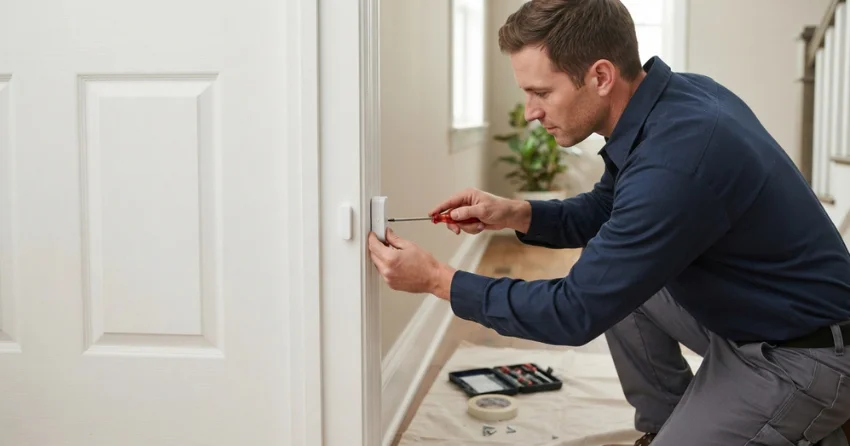
Our technicians align the sensor and magnet within the manufacturer's specified gap, typically within half an inch, since a misaligned contact either reports the door as permanently open or fails to trigger at all when it actually opens. Every contact gets tested for reliable open and closed reporting before the technician moves to the next entry point, rather than trusting a visual installation check alone.
Proper alignment is the single biggest factor in whether a contact sensor works reliably over time, and it is also the most common thing DIY installers get wrong. If the gap between the sensor and magnet is too wide, the panel may report the door as constantly open, or the contact may fail to register at all when the door actually opens and closes.
Door sag and settling over time can push a properly aligned contact out of tolerance months after a correct installation, particularly on older doors or in homes across Markham that experience seasonal humidity swings affecting wood frames. A contact that worked perfectly at installation is not guaranteed to stay that way indefinitely without occasional verification.
This is one reason a proper Door And Window Contact Installation Markham includes a note on which openings are most likely to need re-checking as seasons change, rather than treating every contact as a permanent, set-and-forget installation. A homeowner who knows which specific doors tend to drift out of alignment can catch the issue before it produces a false alarm or, worse, a silent failure that goes unnoticed until it matters.
A door or window contact gets assigned a specific zone type in the panel's programming, which determines how the system responds when that entry point opens. Entry/Exit zones give the homeowner a delay window to disarm the system after opening a main door, Perimeter zones trigger immediately with no delay, and Interior Follower zones only activate after an entry delay zone has already been tripped.
Assigning the wrong zone type to a contact creates real problems: a front door programmed as Perimeter instead of Entry/Exit triggers an immediate alarm every time the homeowner comes home, while a back window mistakenly set to Entry/Exit gives an intruder a delay window that a Perimeter zone would have denied them. Getting this programming correct is as important as the physical installation itself.
Homeowners who take over an existing system, whether through a home purchase or a provider switch, sometimes inherit zone programming nobody has reviewed in years, and mismatched zone types can sit undetected for a long time since they only become obvious during an actual entry event. Reviewing the zone assignment for every contact during a system takeover catches this before it becomes a problem in the moment it matters most.
A ground-floor window that a homeowner does not use as a regular entry point almost always warrants an immediate Perimeter response rather than a delayed one, since there is no legitimate reason for that window to open while the system is armed.
The primary door used for daily access needs an Entry/Exit delay long enough for the homeowner to reach the keypad but short enough that it does not give an intruder meaningful extra time inside before the alarm sounds.
Several patterns point to door and window contacts that are not doing their job correctly, regardless of how long ago they were installed.
Any one of these signs justifies a reassessment. Multiple signs together usually mean the contacts were never properly aligned or programmed to begin with.
New doors and windows installed during a renovation across Markham need their alarm contacts reinstalled as part of the project, since the old contact hardware rarely transfers cleanly to new frames with different dimensions or materials. This is easy to overlook when a renovation project focuses on the visible finish work rather than the alarm system underneath it.
Coordinating contact installation with a renovation timeline, rather than as an afterthought once construction is finished, avoids drilling into freshly finished trim or discovering a coverage gap only after the project is complete and the alarm company has already left the site. Contractors managing the broader renovation rarely flag the alarm system as their responsibility, which means the homeowner is usually the one who has to remember to schedule this step before the crew moves on to the next job.
A recessed Door And Window Contact Installation Markham is often the natural choice on newly renovated openings, since the fresh trim has not yet been finished and painted around a visible surface-mounted sensor. Timing the alarm work to land before final paint and trim, rather than after, produces a cleaner result than retrofitting a recessed contact into finished woodwork later.
Door And Window Contact Installation Markham with Electrical Services Ontario starts with the right contact type and mounting method for each specific opening, not a single default applied to every door and window on the property. Call (289) 672-2825 or contact us to get a technician out for a full assessment of your property's entry points, including a recommendation for which openings genuinely benefit from a recessed or glass-break upgrade.
Electrical Services Ontario is fully licensed and insured, and every Door And Window Contact Installation Markham we complete is backed by a satisfaction guarantee on both the hardware and the programming. With 15 years of experience installing and troubleshooting contact sensors across homes with every door and frame type imaginable, our technicians get the alignment and zone programming right on the first visit, so callbacks for a misaligned sensor or a mis-programmed zone are rare rather than routine.
Every service call starts with a unique situation. Here are the common issues customers contact us about and how our team handles them.

Tell us what is happening — no power, a breaker that will not reset, or a planned upgrade. We talk it through and book a time that works for you, including same-day for urgent calls.
A licensed electrician looks at the actual panel, circuit, and load rather than quoting over the phone, then gives you a firm written price with the scope set out line by line.
The electrician who quoted the job does the work. Drop sheets go down, permits are filed where the work calls for it, and you get an update before anything changes from the plan.
Every circuit is tested before we close the panel, the inspection is booked and the certificate handed over, and our labour is warrantied for two years.
Reach out to Electrical Services Ontario for panel upgrades, rewiring, EV chargers, generators, or emergency electrical repairs across Markham.
Call, or send a message through the form below, either way an electrician gets back to you rather than a call centre.
CALL US (289) 672-2825 EMAIL US Click to send a messageYour message stays between us.

