

Get Your Quote for Elevator Access Control Integration
Fill the form below to inquire about Electrical Services Ontario's Elevator Access Control Integration in Kitchener.
Call Electrical Services Ontario at (289) 672-2825 for Elevator Access Control Integration in Kitchener and control it floor by floor.
Fill the form below to inquire about Electrical Services Ontario's Elevator Access Control Integration in Kitchener.

An elevator with no floor restrictions means anyone who steps inside can reach every unit, office, or amenity space in the building. Elevator Access Control Integration Kitchener closes that gap by tying the elevator's floor buttons directly into the same credential system controlling the building's doors.
Most buildings install door access control first and treat the elevator as an afterthought, which leaves a significant hole in an otherwise secure property throughout Kitchener. A tenant's key fob might open the lobby and their own suite, but if the elevator itself has no restriction, that same person, or anyone who follows them into the cab, can press a button for any floor in the building. Electrical Services Ontario closes that gap with integration work that connects the elevator's internal wiring to the credential system already protecting the doors.
A building can have excellent door security and still leave every floor exposed if the elevator itself has no restriction layer for properties in Kitchener. Multi-tenant office buildings, apartment towers, and hotels all share this same vulnerability: once someone is inside the elevator cab, nothing stops them from pressing a button for a floor they have no business visiting. Restricting floor selection based on the credential presented closes that gap without changing how tenants use the building day to day.
Hotels use this to keep guest floors accessible only to paying guests and staff, while multi-tenant office buildings use it so one company's employees cannot wander into another tenant's suite floor. Residential towers apply the same logic to protect vulnerable residents from unauthorized visitors reaching their floor unannounced. The underlying need across Kitchener is consistent even when the building type changes.
Two main integration paths exist, and the right one depends entirely on the elevator's existing controller in Kitchener. Relay-based integration is the more common setup in legacy or mid-size buildings, where an access control relay board wires directly into the elevator's floor button circuit. When a valid credential is presented, the board activates the relay for the permitted floor, and when no credential is presented, that floor button stays unresponsive.
Destination dispatch integration works differently for properties throughout Kitchener. A user scans their credential at a reader before boarding, and the system assigns a specific elevator and floor automatically rather than relying on in-cab button restriction. This approach is more common in newer high-rise buildings with multiple elevator banks, since it improves traffic efficiency as well as security. Our technicians assess which approach fits the existing elevator controller before recommending a path.
Typical costs range from $2,000 to $10,000 per elevator depending on the building size, the number of floors requiring restriction, and whether mobile credentials or biometric readers are included. Small buildings with straightforward relay-based integration sit toward the lower end, while larger properties with multiple elevator banks sit higher. Contact Electrical Services Ontario for a quote specific to your building.
Relay-based integration wires directly into the elevator's floor button circuit, disabling buttons for floors a credential is not authorized to access, and is more common in legacy or mid-size buildings. Destination dispatch has users scan a credential before boarding, and the system assigns a specific elevator and floor automatically, which is more common in newer high-rise buildings with multiple elevator banks.
Yes, in most cases. Relay-based systems can be retrofitted into most elevator controllers, though older or proprietary controllers sometimes need an additional interface module to bridge old and new systems correctly. Electrical Services Ontario assesses the specific controller before proposing a solution.
Most relay boards restrict a set number of floors out of the box, typically around 10, and can be expanded with additional relay boards for taller buildings. A property's floor count determines exactly how many relay points a project needs before hardware is ordered.
Yes. A properly integrated system connects to the building's fire alarm and emergency systems so floor restrictions release automatically during an evacuation event, ensuring occupants are never trapped behind a credential requirement while trying to exit. This connection is tested as its own step before a project is considered complete.
Yes, this is one of the most common reasons buildings add elevator access control. Each credential issued permits certain floors while denying others automatically, which lets multi-tenant office buildings restrict one company's floor from another company's employees without needing separate elevators.
Yes. Electrical Services Ontario confirms the project scope with the building's existing elevator maintenance provider before beginning any wiring work, since uncoordinated work on elevator systems can void service agreements or create liability issues.
A single elevator with a compatible controller typically takes 1 to 2 days to complete, including installation and floor-by-floor testing. Larger properties with multiple elevator banks or older controllers requiring interface modules can take a week or more, and work is usually scheduled after hours to minimize disruption to tenants.
The access control panel sits between the credential reader and the elevator's internal wiring, acting as the decision point for every floor request in buildings throughout Kitchener. When a valid credential is presented, the panel activates the relay corresponding to the floors authorized for that specific credential, and every other floor button remains disabled for that ride. This happens in under a second, so riders experience no delay compared to an unrestricted elevator.
Relay boards typically restrict access to a set number of floors out of the box, often around 10, and can be expanded with additional relay boards for taller buildings across Kitchener. Our team calculates exactly how many relay points a specific building needs before ordering hardware, since underestimating floor count on a taller property means a return trip to add expansion boards later.
Office buildings shared by several companies are one of the most common applications our team handles in Kitchener. A tenant occupying the second floor typically wants employees and visitors from other companies in the building kept off that floor entirely, and floor-level restriction accomplishes exactly that without requiring separate elevators for each business. Each credential issued permits certain floors while denying others automatically.
This same logic extends to shared amenity floors in mixed-use buildings, where a gym, rooftop terrace, or conference space needs to stay open to some tenants but closed to others. Configuring these exceptions correctly during Elevator Access Control Integration Kitchener avoids the common mistake of granting blanket access that defeats the purpose of restricting the rest of the building.
Hotels restrict elevator access to guest floors so only paying guests and authorized staff can reach the rooms across Kitchener, which reduces theft and unauthorized entry meaningfully compared to an open elevator. Room key cards typically double as the floor credential, so guests do not carry a separate device beyond what they already use for their door. This dual-purpose approach also means staff issuing room keys at check-in are simultaneously provisioning elevator access, with no separate step required.
Residential towers apply the same restriction to protect residents, particularly in buildings with families or elderly residents who benefit from knowing unauthorized visitors cannot simply ride the elevator to their floor. Electrical Services Ontario configures residential systems so guests can still be granted temporary floor access when a resident authorizes a visit, without opening the whole building. Property managers across Kitchener also use this same temporary-access feature for contractors and delivery personnel who need one-time access to a specific unit.
Physical key cards and fobs remain the most widely deployed elevator credential in Kitchener, read by an RFID reader mounted inside the cab or near the call button in the lobby. This approach is familiar to tenants and inexpensive to issue, though lost or shared cards remain a real weakness since anyone holding the card gets whatever floor access it carries. Replacing a lost card also takes staff time and a small material cost that adds up across a large building over the years.
Mobile credentials are becoming a common addition to Elevator Access Control Integration Kitchener projects, letting users authenticate with a smartphone instead of a physical card. This reduces the ongoing cost of replacing lost cards and gives property managers the ability to revoke a departing tenant's access instantly rather than waiting for a card to be physically returned. Most mobile-enabled systems still support physical cards alongside phones, so buildings can transition gradually instead of forcing every resident onto a new credential type at once.
Card-only systems cost less up front and require no smartphone app adoption from residents or staff, which suits buildings with a less tech-comfortable tenant base or a tight initial budget across Kitchener. Mobile-enabled systems cost more to deploy but eliminate the ongoing expense of card replacement and give management real-time control over who can access which floor. Buildings with high tenant turnover, such as student housing or corporate rentals, tend to see the mobile option pay for itself fastest since credential provisioning and revocation happen instantly rather than requiring a physical card exchange. Our team walks through both options with property managers before recommending one, since the right choice depends heavily on the specific tenant mix and how the building expects to grow over the next several years.
Fingerprint or facial recognition readers add a layer beyond what a card or phone alone can provide, since a credential cannot be lent or stolen the way a physical card can. These are typically reserved for specific high-security floors, such as data centers or executive suites, rather than deployed building-wide given the higher per-point cost. A building might run a standard card system for residential floors while adding biometric verification specifically for a server room or records floor that carries a higher security requirement. This mixed approach keeps overall costs reasonable while still hardening the floors that genuinely need it, rather than paying for building-wide biometric hardware that most floors never require. Enrollment for biometric credentials also takes longer than issuing a card, so buildings adopting this option should plan for a dedicated enrollment period before the floors go live.
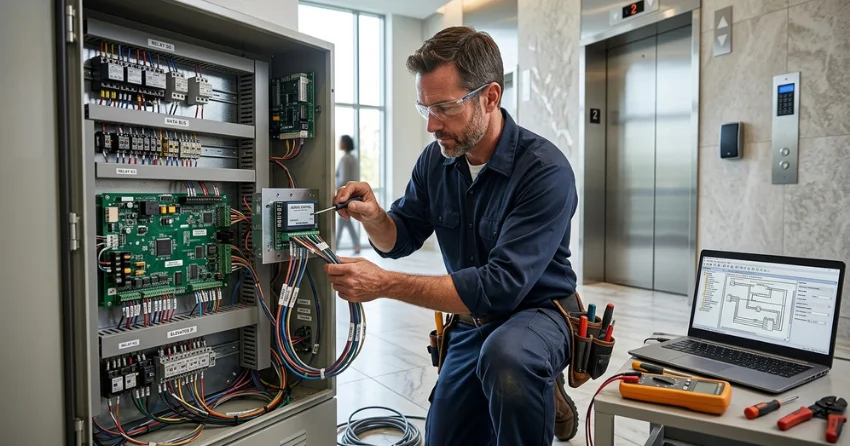
Elevator access control rarely operates as a standalone system in a well-planned building throughout Kitchener. Our technicians connect the elevator integration to the same access control software already managing doors, so property managers see a single unified log of who accessed which floor and when, rather than checking separate systems for door activity and elevator activity. This unified view also makes investigating an incident far faster, since a single search covers every access point in the building instead of cross-referencing two separate logs.
This integration also allows the elevator system to respond to triggers from fire alarm and emergency systems throughout Kitchener, releasing floor restrictions automatically during an evacuation event so occupants are never trapped behind a credential requirement while trying to exit. Coordinating this connection correctly is one of the most safety-critical parts of the whole project, and our team tests the fire alarm override specifically as its own step before considering the integration complete.
A project starts with a site assessment of the existing elevator controller in Kitchener, since relay-based and dispatch-based systems require entirely different hardware and wiring approaches. Our technicians document the number of floors, the existing controller manufacturer, and any planned amenity or restricted floors before proposing a specific solution. This assessment also confirms whether the building's existing access control software can absorb the elevator integration or whether a software upgrade is needed first.
Installation itself typically happens after hours or during low-traffic windows to minimize disruption to tenants who depend on the elevator daily throughout Kitchener. Once wiring and hardware are in place, every floor and credential combination gets tested individually before the system goes live, confirming that authorized floors work and restricted floors genuinely stay locked out. This floor-by-floor testing catches configuration mistakes before tenants ever notice them, rather than fielding complaints after the system is already live.
Older elevator controllers sometimes use proprietary wiring or outdated relay logic that does not interface cleanly with modern access control hardware, which can turn a straightforward integration into a more involved retrofit. Buildings with elevators installed before digital controllers became standard often need an interface module to bridge the old and new systems correctly. Some legacy controllers also lack the documentation needed to identify wiring paths at a glance, which adds diagnostic time before any actual integration work can begin at all. Two specific challenges come up often enough that our team plans for them at every retrofit assessment, since catching them early keeps a project on schedule and avoids surprise costs mid-installation on an older elevator system across Kitchener.
Some elevator manufacturers use proprietary control logic that standard access control relay boards cannot interface with directly and without modification. In these cases, our team sources or builds an interface module specific to that controller, which adds cost but avoids replacing the elevator controller entirely and keeps the project's overall budget from ballooning unexpectedly. Confirming this compatibility early avoids ordering standard hardware that then sits unused once the incompatibility becomes apparent on site during the actual installation visit. Buildings with elevators from smaller or discontinued manufacturers are the most likely to run into this issue, since parts and documentation for those systems are harder to source than for major national brands still actively supported today by their original manufacturer's service network.
Buildings that have changed ownership or management over the years sometimes have no record of how the elevator's original wiring was laid out across Kitchener. Our technicians trace the relevant circuits on site rather than relying on documentation that may no longer match what was actually installed. This tracing step adds time to the assessment phase but prevents mistakes that would otherwise only surface once wiring work is already underway.
Our team identifies these compatibility issues during the initial assessment rather than discovering them mid-installation, since a surprise mid-project adds cost and delay that a proper upfront evaluation avoids. Property owners across Kitchener dealing with an aging elevator system get an honest assessment of whether integration is straightforward or will require additional interface hardware, along with a clear explanation of how that affects both timeline and cost.
Typical costs for Elevator Access Control Integration Kitchener range from $2,000 to $10,000 per elevator depending on the building size, the number of floors requiring restriction, and whether mobile credentials or biometric readers are included. Small buildings with straightforward relay-based integration sit toward the lower end, while larger properties with multiple elevator banks or destination dispatch requirements sit higher. Contact us via contact us or call (289) 672-2825 to get a quote specific to your building.
Multi-elevator properties throughout Kitchener typically see a lower per-elevator cost once the initial assessment and controller integration work is planned across the whole bank rather than elevator by elevator. Our team provides a clear scope before work begins so property managers know exactly what the investment covers, including which floors get restricted, what credential types are supported, and how the fire alarm override is configured.
Certain situations point clearly to a building that has outgrown door-only security. Recognizing them early helps property owners budget for the project before an incident forces the issue.
Any one of these situations justifies scheduling an assessment. Buildings dealing with several at once usually see the fastest return on the investment once restrictions are properly in place.
Electrical Services Ontario is fully licensed and insured, and every Elevator Access Control Integration Kitchener project is backed by a satisfaction guarantee on the finished system. With 15 years of experience across commercial and residential access control work, our technicians understand both the electrical wiring side and the coordination required with elevator service contractors. That dual expertise matters, since an integration that ignores the elevator's own service requirements can create problems the access control system alone would never catch.
We never begin wiring work on an elevator controller without confirming the scope with the building's existing elevator maintenance provider, since uncoordinated work on elevator systems can void service agreements or create liability issues. That coordination is why property managers throughout Kitchener trust our team with a system as safety-critical as elevator access, rather than treating it as just another access control point.
Electrical Services Ontario has completed elevator integration projects on buildings ranging from a single small elevator to full multi-tower properties throughout Kitchener with several banks running simultaneously, which means our team has already encountered most controller types a property is likely to have. That range of experience shortens the assessment phase and reduces surprises once installation begins.
Property managers considering Elevator Access Control Integration Kitchener for the first time often start with one elevator bank as a pilot before expanding to the rest of the property, which lets them evaluate real-world performance before committing to a building-wide rollout. Our team supports that phased approach just as readily as a full simultaneous installation. Call (289) 672-2825 or contact us to schedule a site assessment, and our team will confirm a time that works around your building's traffic patterns and existing elevator service schedule.
Every service call starts with a unique situation. Here are the common issues customers contact us about and how our team handles them.

Tell us what is happening — no power, a breaker that will not reset, or a planned upgrade. We talk it through and book a time that works for you, including same-day for urgent calls.
A licensed electrician looks at the actual panel, circuit, and load rather than quoting over the phone, then gives you a firm written price with the scope set out line by line.
The electrician who quoted the job does the work. Drop sheets go down, permits are filed where the work calls for it, and you get an update before anything changes from the plan.
Every circuit is tested before we close the panel, the inspection is booked and the certificate handed over, and our labour is warrantied for two years.
Reach out to Electrical Services Ontario for panel upgrades, rewiring, EV chargers, generators, or emergency electrical repairs across Kitchener.
Call, or send a message through the form below, either way an electrician gets back to you rather than a call centre.
CALL US (289) 672-2825 EMAIL US Click to send a messageYour message stays between us.

